
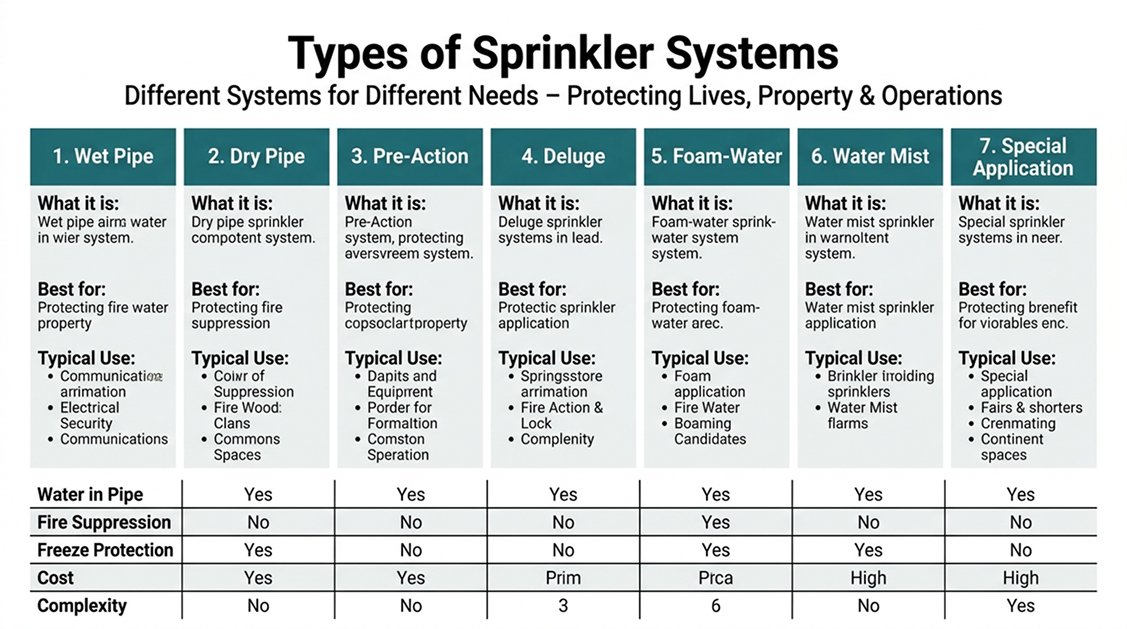
Choosing the right sprinkler system is one of the most consequential decisions in MEP design. The wrong system type can result in regulatory non-compliance, inadequate protection, or unnecessary cost. Understanding the differences between system types — and when to specify each — is essential knowledge for BIM modellers, MEP engineers, and project teams.
1. Wet Pipe System
The most common type. Pipes are always filled with water. When a sprinkler head activates due to heat, water discharges immediately. Best suited for areas with consistent temperatures above 4°C. Typical applications include residential buildings, offices, schools, and commercial buildings.
Key design consideration: Ensure pipes are properly graded and drained for maintenance. Model auxiliary drain points at all low points in the system.
2. Dry Pipe System
Pipes are filled with pressurised air or gas. Water only enters when a sprinkler activates and the air pressure drops. Ideal for unheated areas prone to freezing such as warehouses, parking garages, attics, and loading docks.
Key design consideration: NFPA 13 requires a minimum slope of 1 in 240 (0.42%) for branch lines and 1 in 120 (0.83%) for main lines to ensure drainage. Model slope and auxiliary drains accurately in Revit.
3. Pre-Action System
Pipes are filled with air or gas, but a detection system must activate before water enters the pipe. This double interlock prevents accidental discharge. Used in data centres, museums, libraries, and server rooms where water damage would be catastrophic.
Key design consideration: Coordinate the detection system layout with the sprinkler layout in the BIM model to ensure coverage alignment.
4. Deluge System
Open sprinklers connected to a deluge valve. Water discharges from all heads simultaneously when the valve opens. Used in high-hazard areas requiring immediate full coverage — oil and gas facilities, chemical plants, aircraft hangars, and industrial areas.
Key design consideration: Hydraulic calculations must account for simultaneous full-system discharge. Model pipe sizes carefully to handle full flow.
5. Foam-Water System
A foam solution is discharged to suppress flammable liquid fires. Used in fuel storage areas, petrochemical plants, aircraft hangars, and tank farms. The foam blanket smothers the fire and prevents re-ignition.
Key design consideration: Foam concentrate storage and proportioning equipment must be coordinated in the BIM model alongside the pipe network.
6. Water Mist System
Discharges extremely fine water droplets that absorb heat and suppress fire through cooling and oxygen displacement. Used in museums, data centres, turbines, hospitals, and other sensitive or high-value environments where conventional sprinklers are not suitable.
Key design consideration: High-pressure systems require specialised pipe materials and fittings. Nozzle placement is critical for effectiveness.
7. Special Application Systems
Designed for specific hazards using special agents or configurations — typically gaseous suppression agents. Used in gas suppression systems, clean agent systems, and Inergen systems in areas where water would damage critical equipment.
Why Sloped Pipes Matter
Sloped piping is used when water must drain properly from the system. The main reasons are: to avoid trapped water, prevent freezing, reduce corrosion, avoid water accumulation, and ensure system reliability. Dry pipe and pre-action systems always require sloped pipes. Wet systems generally use level piping unless drainage is specified.
Key Takeaway
Choose the right sprinkler system based on building type, fire risk, environmental conditions, and operational needs. The right system saves lives, minimises damage, and ensures code compliance. At AxioBIM, we model all fire protection systems to LOD 350 as standard — coordinating with structure, MEP services, and ceiling systems to produce clash-free, construction-ready deliverables.