
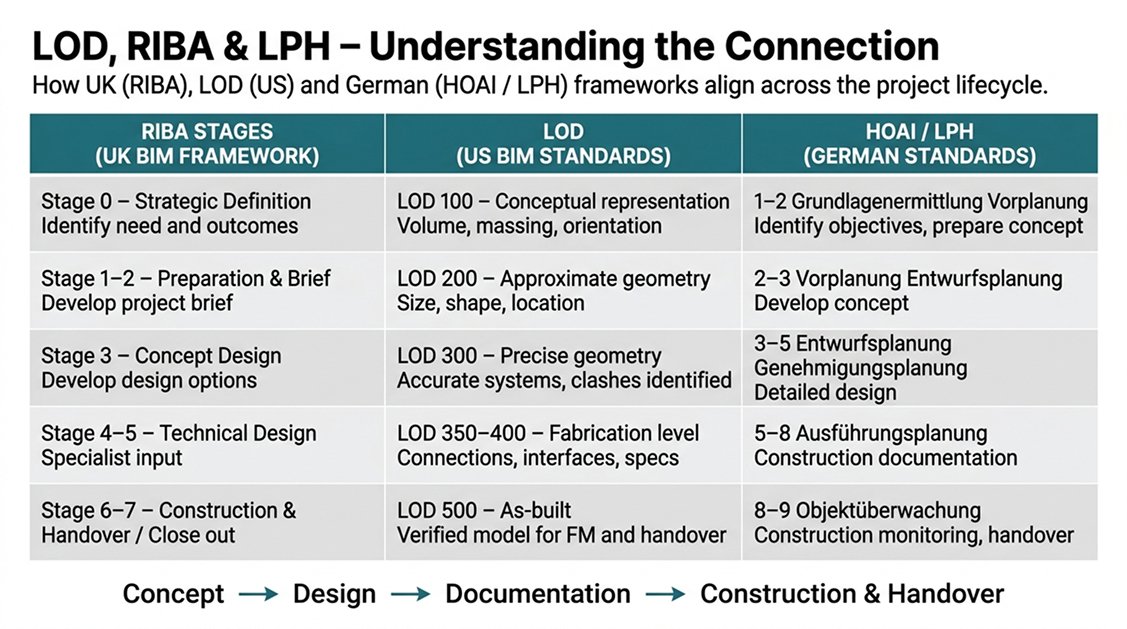
When working on international construction projects, one of the most common sources of confusion is the use of different project stage frameworks across different countries. The UK uses RIBA stages, the US uses LOD (Level of Development), and Germany follows the HOAI / LPH phases. While the terminologies differ, the intent is the same — delivering the right information at the right time.
Why This Matters
Understanding the alignment between RIBA, LOD and LPH helps improve communication, set expectations, and maintain quality across international projects. At AxioBIM, we work with clients from multiple regions and having a clear framework mapping is essential for seamless project delivery.
RIBA Stages (UK BIM Framework)
The Royal Institute of British Architects (RIBA) Plan of Work divides a project into eight stages from Stage 0 (Strategic Definition) through to Stage 7 (Use). Each stage defines the design activities, information requirements, and deliverables expected from the project team.
LOD Framework (US BIM Standards)
The Level of Development framework, developed by the American Institute of Architects (AIA) and BIMForum, defines the content and reliability of BIM elements at five levels — LOD 100 through LOD 500. Each level specifies not just geometry, but the authorised uses of that information.
HOAI / LPH (German Standards)
The Honorarordnung für Architekten und Ingenieure (HOAI) defines nine service phases (Leistungsphasen / LPH) for building and engineering projects in Germany. These phases cover everything from basic evaluation through to object monitoring and documentation.
How They Align
The three frameworks map closely when viewed at a high level. Conceptual stages (RIBA 0–2 / LOD 100–200 / LPH 1–3) focus on massing, intent, and early design. Design development stages (RIBA 3 / LOD 200–300 / LPH 3–5) refine the design and begin coordination. Technical and documentation stages (RIBA 4–5 / LOD 350–400 / LPH 5–8) cover fabrication-level detail and construction preparation. The final stages (RIBA 6–7 / LOD 500 / LPH 8–9) cover construction, handover, and as-built documentation.
Practical Application
When working with international teams, we recommend establishing a project-specific stage alignment table at the start of the BIM Execution Plan. This prevents misunderstandings about what level of detail is expected at each milestone and ensures all parties are working toward the same deliverable standards.
If you’re working on a cross-border project and need help aligning your BIM workflows, reach out to our team for a consultation.